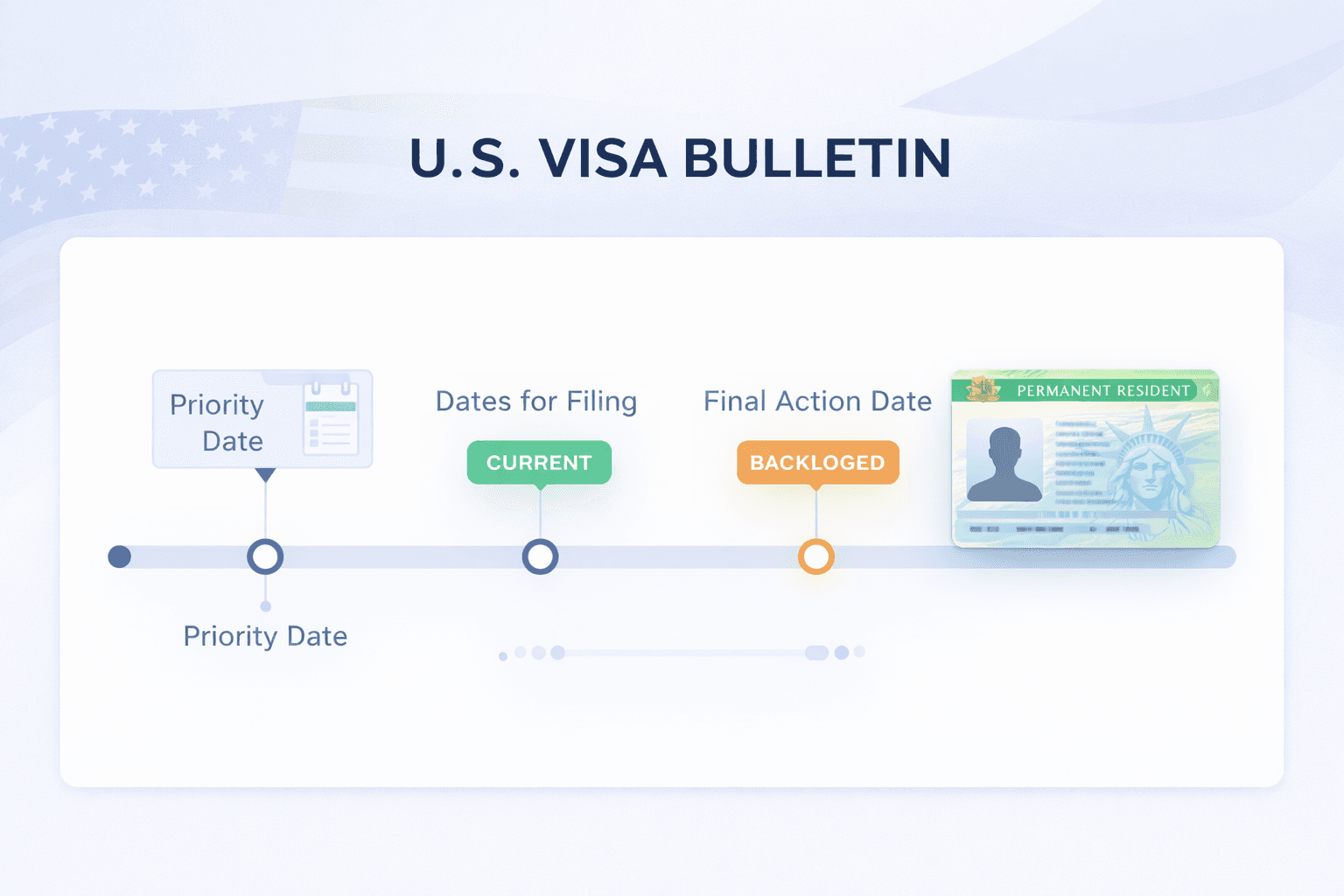
Navigating the U.S. immigration system as a green card applicant can be overwhelming. While many focus on their job, sponsor, or length of residency, the U.S. Visa Bulletin remains one of the most critical yet misunderstood parts of the process.
This guide aims to demystify the Visa Bulletin, addressing key questions such as what it is, how to find your place in line, and the "hidden rules" that can speed up (or slow down) your journey.
What Is the U.S. Visa Bulletin?
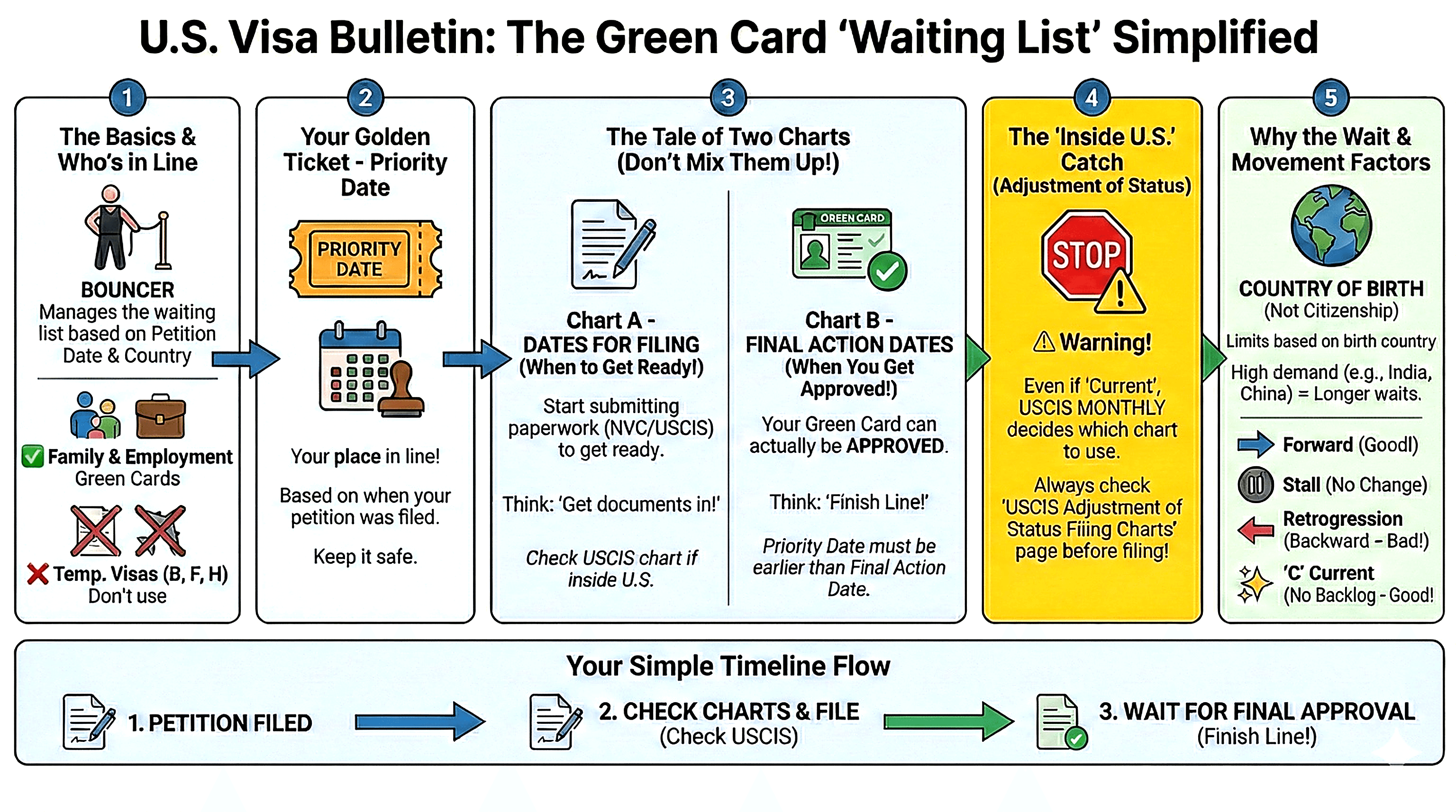
The U.S. Visa Bulletin is a monthly publication released by the Department of State. Its purpose is to manage the "waiting line" for green cards. Because U.S. law limits the number of green cards issued each year based on country of origin and visa category, not everyone who qualifies can receive one immediately. The Visa Bulletin controls this flow.
If you are applying for a green card through family or employment, this document determines when you are allowed to submit your final paperwork and when your green card can be approved.
Step 1: Know Your "Priority Date"
Your Priority Date is effectively your "ticket number" in the waiting line. You cannot move forward until your number is reached.
Where do I find it? Look at the Notice of Action (Form I-797) you received when your sponsor first filed your petition. Your Priority Date is listed in a box on the top-left corner.
The Rule: You must keep this date safe! It determines your exact place in line.
Step 2: Know Your Category Code
The Visa Bulletin doesn't just say "Spouse" or "Worker"; it uses specific codes. To read the chart, you need to know which code matches your petition. Check your I-797 form to see exactly which category you fall under.
Common Category Codes:
F1: Unmarried sons/daughters of U.S. Citizens.
F2A: Spouses and children of Green Card Holders.
EB-1 / EB-2 / EB-3: Employment-based categories for workers.
Why Are There Two Different Charts?
The Visa Bulletin contains two distinct charts, and mixing them up is a common mistake. Each serves a different purpose:
1. Dates for Filing: This chart signals when you are eligible to begin submitting your green card paperwork. It tells you, "Get your documents ready; we are almost ready for you."
2. Final Action Dates: This chart represents the finish line. If your Priority Date is earlier than the date listed here, your green card can actually be approved and issued.
Navigating the Visa Bulletin: A Comprehensive Guide
1. Understanding "Current" (C) and "Unavailable" (U):
'C' (Current): If you see a 'C' under your category, celebrate! It means there is no backlog for your country. You can file your application or receive approval immediately.
'U' (Unauthorized/Unavailable): If you see a 'U', it means no green cards are being issued for this category right now. Don't panic—this is usually temporary and often happens near the end of the fiscal year (September).
2. The "Inside the U.S." Exception: If you are already in the U.S. and applying for Adjustment of Status, there is a critical extra step. Even if the "Dates for Filing" chart says you are current, USCIS decides separately each month whether they will honor that chart or if they require you to use the "Final Action" chart. You must check the specific USCIS Adjustment of Status Filing Charts page before mailing your application to avoid rejection.
3. Monitoring for "Retrogression": Sometimes, dates on the bulletin move backward. This process, known as retrogression, happens when too many people apply at once, and the government must pause or push back the line to catch up.
4. Country of Birth Limits: The bulletin separates applicants by country of birth, not citizenship. High-demand countries like India, China, Mexico, and the Philippines often have specific dates and longer waiting times.
💡 Immplify Pro Tip: Cross-Chargeability If you were born in a country with a long backlog (like India or China) but your spouse was born in a country with no backlog (like France), you can often "borrow" your spouse's country of birth to skip the line! This is called Cross-Chargeability. Ask your lawyer if this applies to you.
Addressing Frequently Asked Questions
Which chart determines when I get my Green Card? The Final Action Dates chart determines when your green card can be approved. The Dates for Filing chart only tells you when you can submit the initial paperwork.
Why did my priority date move backward? This is called "Retrogression." It occurs when the annual limit for visas in your category has been reached or exceeded, forcing the Department of State to push the cut-off dates back to limit new approvals.
Do students on F-1 visas need to check the Visa Bulletin? No. Temporary visas like F-1 (student), B1/B2 (tourist), and H-1B (work) do not rely on the Visa Bulletin. It only becomes relevant if you decide to apply for permanent residency (a green card).
Disclaimer: The information provided in this article is for general informational purposes only and is not intended as legal advice. Please consult with a qualified attorney regarding your specific immigration situation.