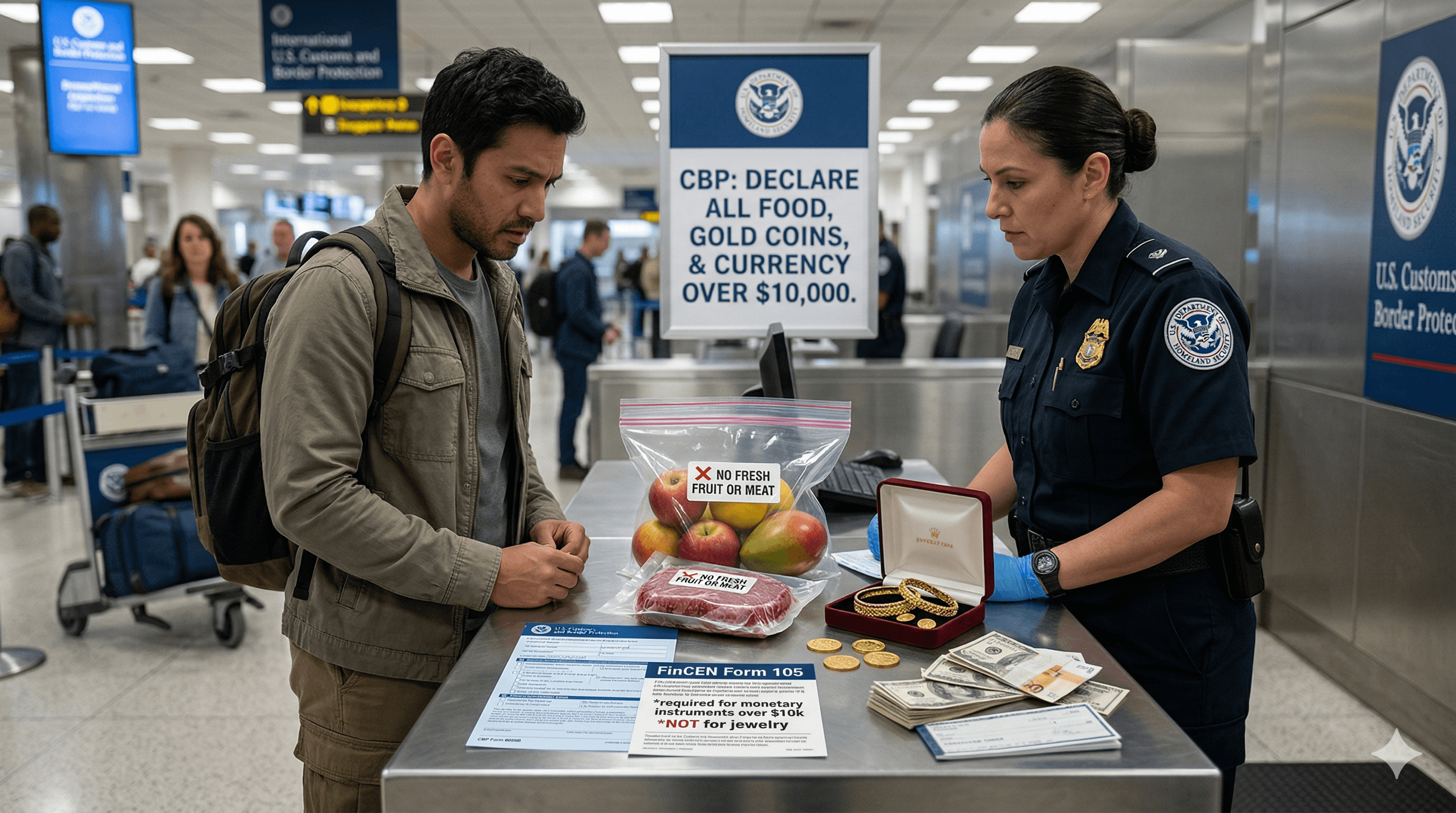
You’ve packed your bags, said goodbye, and are ready to travel to the United States. Maybe you’re bringing snacks from home, some gold jewelry from a shopping trip, or cash for emergencies. But when you land and walk toward baggage claim, you’re handed a Customs declaration form and realize you don’t fully understand what you’re allowed to bring.
This is where many travelers fall into the “Customs Trap.” It’s rarely about breaking the law intentionally; it’s about not knowing the rules and facing unexpected consequences like fines, seizure of items, or even visa complications.
When you enter the United States, you go through U.S. Customs and Border Protection (CBP). Their job is to inspect what you are bringing into the country and make sure nothing harmful, illegal, or undeclared enters. The categories that receive the most attention are food, gold, and cash. Knowing the rules before you travel makes the process smoother and keeps your trip stress-free.
Food: Snacks, Ingredients, and Meals
Food is one of the biggest areas where travelers make mistakes. The U.S. has strict rules about agricultural products to protect domestic crops and prevent foreign pests and diseases from taking root. Many travelers are surprised to learn that even a small piece of fruit saved from an in-flight meal can trigger a penalty.
Prohibited food items generally include:
Fresh fruits and vegetables
Seeds and live plants
Fresh meat, poultry, or homemade meat dishes
Dairy products from certain countries
Even if the food is sealed, gifted, or intended for personal use, CBP may confiscate it. However, commercially packaged snacks such as chips, cookies, candy, roasted coffee, and dried tea leaves are generally allowed. Spices are allowed in most cases, provided they are not seeds meant for planting.
Key Rule: When in doubt, declare it. Declaring food does not automatically mean it will be taken away. Hiding it, however, is considered a false declaration and can result in heavy fines.
Gold and Valuable Items: Jewelry, Coins, and Gifts
Many travelers carry gold for personal use or as gifts, especially from weddings or cultural events. U.S. Customs evaluates gold based on its form, quantity, and value.
Personal jewelry you are wearing is usually fine. Problems arise when you carry multiple pieces, new items in packaging, or high-value amounts that could be considered commercial merchandise.
How to declare gold correctly:
Gold Jewelry and Bullion: These are legally classified as merchandise. You must write their total value and description on your standard Customs Declaration form (CBP Form 6059B). They do not require a FinCEN 105 form, regardless of how much they are worth.
Gold Coins: Because coins are considered legal tender, they are classified as "monetary instruments." If the value of your gold coins, combined with any cash you are carrying, exceeds $10,000, you must file FinCEN Form 105.
Keeping purchase receipts, documenting the source of the gold, and providing accurate values will protect you from seizures and make the inspection process much faster.
Cash and Financial Instruments: The $10,000 Myth
Many travelers believe there is a strict $10,000 limit on what they can bring into the U.S. This is a myth. There is no legal limit to how much money you can bring into the country.
However, you are legally required to report it if your total combined amount exceeds $10,000. This threshold applies to:
U.S. or foreign cash
Traveler’s checks
Money orders
Negotiable instruments (like endorsed checks)
You report this using FinCEN Form 105. Failing to declare an amount over $10,000 can lead to the seizure of all your money, civil penalties, or even criminal charges. The U.S. government simply wants to track the movement of large sums of money to prevent illegal activities; they are not trying to take your legally acquired savings.
The Traveler’s "Cheat Sheet"
To keep your entry stress-free, follow this simple rulebook:
Category | Declaration Rule |
Food | Always declare it, even commercially packaged snacks. |
Gold Jewelry & Bullion | Declare as merchandise on your standard Customs form (CBP Form 6059B). |
Cash & Gold Coins | If the combined total exceeds $10,000, file FinCEN Form 105. |
Uncertainty | Ask a CBP officer. Honesty is your best legal protection. |
The “Customs Trap” is not a punishment for travelers; it is a protective system to ensure items entering the U.S. are safe, legal, and accounted for. Being informed, honest, and proactive about your declarations is the key to traveling confidently and avoiding unnecessary stress.
Immplify provides general information to help you navigate U.S. immigration and settlement. This is not legal, tax, or financial advice. For decisions specific to your situation, please consult a licensed attorney or qualified professional.