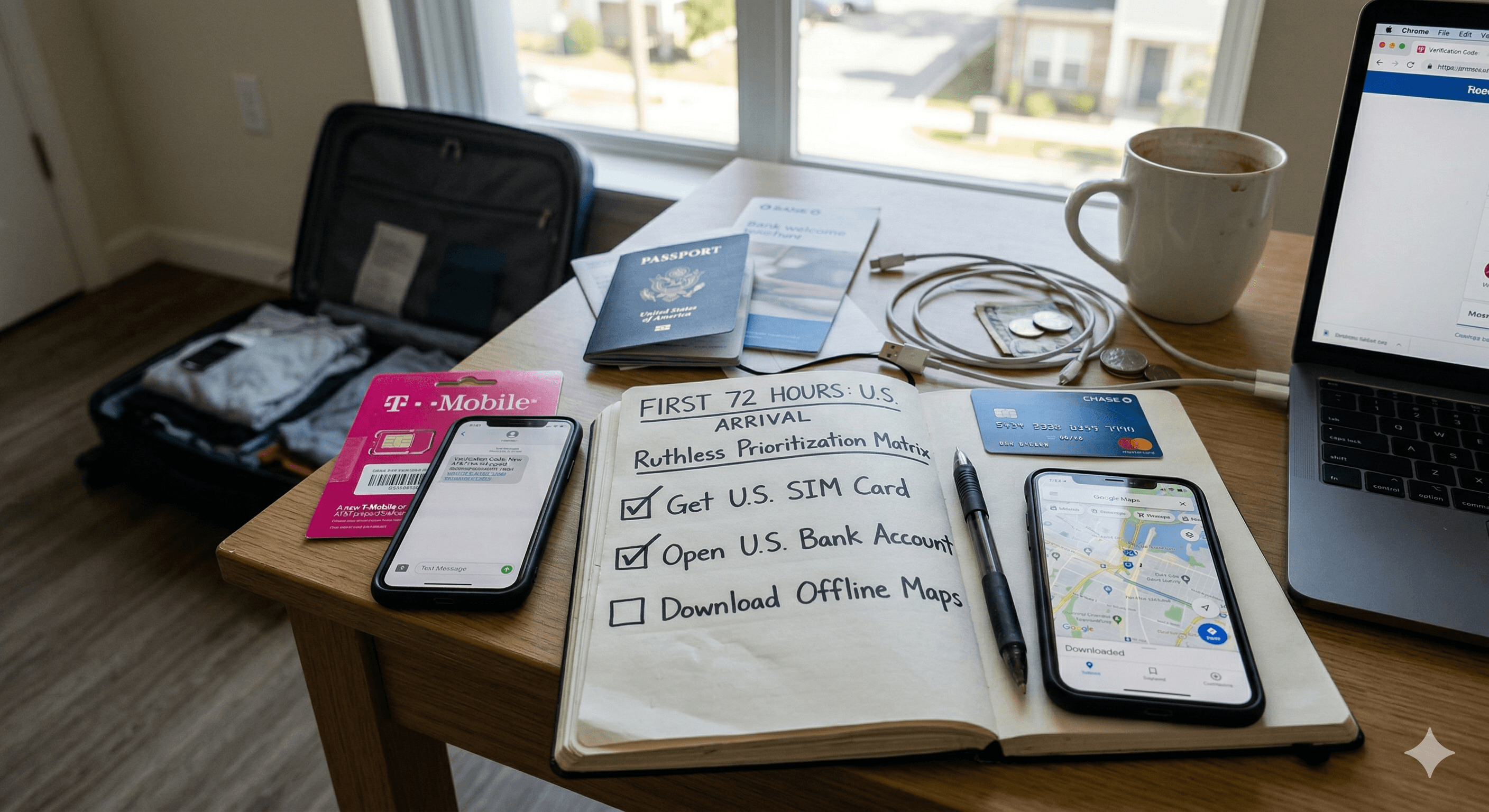
You just landed in the United States. You are jet-lagged, slightly overwhelmed, and trying to process a mountain of instructions from your school, employer, or relatives. Everything feels urgent.
It is not.
The first 72 hours are not about sightseeing or filling your social calendar. They are about building the basic systems that allow you to function. Focus on the wrong things, and small hiccups turn into stressful crises. Focus on the right three tasks, and everything else falls into place.
This is your ruthless prioritization matrix. Secure the essentials first; everything else can wait.
Why the First 72 Hours Matter
Your first few days set the tone for your entire transition. Whether you are on an F-1 student visa, an H-1B work visa, or another temporary status, you are entering a system that depends heavily on digital verification, banking infrastructure, and self-navigation.
Without a working phone number, you cannot verify accounts. Without a bank account, you cannot easily receive money or pay bills. Without navigation tools, even simple errands become stressful.
The goal is operational stability before anything else.
Priority 1: Get a Local SIM Card (The Foundation)
Most U.S. platforms rely on two-factor authentication (2FA). This means security codes are texted to you to verify your identity. Banks, school portals, payroll systems, rental platforms, and delivery apps all use this method.
Without a U.S. phone number, you will struggle to:
Receive verification codes
Complete essential account setups
Communicate with employers or landlords
Access basic services
Actionable Advice: Choose a prepaid plan if you lack a U.S. credit history. Activation is usually instant, and you can always upgrade later. Your only objective right now is to secure a reliable U.S. number that receives texts immediately. Do this before attempting to open a bank account, as most banks require a domestic number during registration.
Priority 2: Open a U.S. Bank Account (The Engine)
Once your phone is active, tackle your banking.
Relying on an international card long-term leads to foreign transaction fees and randomly declined payments. Employers typically require direct deposit into a U.S. account, and landlords expect domestic electronic transfers. Even setting up utilities is remarkably easier with a local account.
What to bring to the branch:
Your passport
Visa documentation
I-94 travel record
Proof of U.S. address (even if temporary)
Your new U.S. phone number
Note: Some banks may ask for a Social Security Number (SSN). If you don't have one yet, ask about alternative documentation. Many banks have specific, streamlined processes for international students and new arrivals. Opening your account early reduces financial friction and starts building your U.S. financial history immediately.
Priority 3: Download Offline Maps (The Navigator)
This step seems minor, but it is a massive stress-preventer.
In your first days, you don't know the public transit routes, store locations, or safe walking paths. Public Wi-Fi is spotty, mobile data can drop inside large buildings, and constant GPS navigation drains your battery fast.
Download offline maps for:
Your immediate neighborhood
Your campus or workplace
Nearby grocery stores and pharmacies
The closest hospital or urgent care center
Having offline access means you can navigate confidently without a cell signal. That confidence reduces anxiety far more than most people expect.
The "Not Urgent" List: What Can Wait
In the first 72 hours, intentionally delay low-priority tasks. Decorating your apartment, exploring tourist attractions, attending multiple social mixers, or fully stocking your pantry are not urgent.
When deciding what to do next, ask yourself one question: Does this help me communicate, manage money, or move safely? If the answer is no, it waits until Day 4.
Final Takeaway
The first 72 hours are about control, not excitement.
Secure your phone.
Open your bank account.
Prepare your navigation.
Once these core systems are in place, you shift from reacting to problems to managing your transition strategically.
At Immplify, we believe relocation should feel organized and intentional. Let us help you build a solid foundation, so you can focus on building your new life on top of it.